I'll be honest with you: most people asking about PFAS had never heard the term before this year. Then a headline mentions “forever chemicals”, and suddenly it is everywhere — the news, social media, worried group chats.
Here's what I think you actually need, in order: what PFAS is in plain English; whether it is genuinely relevant to your water rather than “UK water” in general; what testing can and cannot tell you; which filter technologies may reduce it; and what claim or certification to check before you spend money.
Then, if you decide you want a filter, I'll show you the products that have the strongest current evidence. No scare tactics. Just the same information I'd give my own family.
What Are PFAS and Why Should You Care?
PFAS is a large family of man-made chemicals. They have been used for properties such as water, grease and stain resistance in a wide range of products. They are often called “forever chemicals” because many break down very slowly in the environment. The UK Government's PFAS plan recognises both their widespread use and the need to understand and manage their risks. Read the Government PFAS plan.
That does not mean every glass of tap water is a crisis. Different PFAS behave differently, exposure can come from more than one route, and a national headline cannot tell you what is in one kitchen tap. The sensible response is to understand the local context and check the evidence before buying a filter.
Is This Actually Relevant to You?
Local concern can be greater where PFAS has historically been used or released — for example around some industrial activity, airports or firefighting-training locations. But location alone is not a test result, and proximity does not prove that a particular supply is affected. Your supplier's water-quality information and any local environmental information are a better starting point than a national map or social-media post.
Check your supplier and local water context with our UK water-quality lookup →The lookup helps identify your water company and general local context. It does not test your tap for PFAS or confirm a household-level exposure.
What Testing Can and Can't Tell You
Home water kits can be useful for some basic checks, but most do not give a full compound-by-compound PFAS result. Proper PFAS analysis is specialised work: the laboratory needs to say which compounds it tests, how low it can measure, and how the sample should be collected. If you have a specific concern, ask the lab those questions before you pay.
A negative result also has limits. It only reflects the compounds tested, the detection limit, the sample taken and that moment in time. Testing can help you make a calmer decision; it is not a guarantee that every possible PFAS is absent.
PFAS Removal: Filter Types Compared
There is no honest universal percentage for “RO” or “carbon”. Results vary by model, filter condition, flow rate and the particular PFAS tested. The right question is always: what does this exact model's current performance document say?
| Technology | What the evidence can show | What to check before buying |
|---|---|---|
| Reverse osmosis (RO) | Can reduce a broad range of dissolved contaminants; some models publish named PFAS results. | The exact model's performance data sheet, named PFAS and test conditions. |
| Activated carbon | May reduce particular PFAS when the specific filter has supporting test data. | A model-specific PFAS claim, service life and replacement schedule. |
| Ion exchange | Used in some systems for selected PFAS reduction. | Independent documentation for the exact system and compounds. |
| Basic jug filters | Often aimed at taste, odour or limescale rather than named PFAS. | Do not assume PFAS reduction without a named claim and evidence. |
What Certification to Look For
NSF P473 is an NSF testing protocol associated with PFOA and PFOS reduction claims. It is a useful signal, but it is not a shortcut for assuming that every PFAS has been tested or that every filter using the same technology performs alike.
For any product, look for the exact model, the named compounds, the claimed reduction or pass result, the stated filter life and an accessible performance sheet. A model may be certified to NSF/ANSI 53 or 58 for certain claims; that alone does not prove a PFAS claim unless PFAS is named in the model-specific documentation. NSF's consumer guide explains why contaminant-specific claims matter.
Where Else Does PFAS Come From?
Water matters because we drink it every day, but it is not the only possible route. The table below is not a reason to panic or throw everything away. It is a reminder that a water filter addresses one part of a wider picture.
| Possible source | Why it comes up in PFAS discussions | Practical perspective |
|---|---|---|
| Non-stick cookware | Some non-stick coatings have historically used PFAS-related chemistry. | Use cookware as intended and replace damaged items; a water filter does not change this route. |
| Waterproof or stain-resistant clothing | PFAS have been used to create water and stain resistance in some textiles. | Check manufacturer information when buying new items rather than assuming every garment contains PFAS. |
| Food-contact packaging | Grease-resistant treatments have been used in some packaging. | A water filter can only address drinking water, not food-contact materials. |
| Cosmetics and personal care | Some products have used PFAS for texture, wear or water resistance. | Read ingredient and manufacturer information if this is a concern; availability and labelling are changing. |
| Dental floss, carpets and upholstery | Some stain-, glide- or water-resistant treatments have involved PFAS. | These are product-category discussions, not proof that every item in your home contains PFAS. |
A Simple Guide to Which Filter Type Usually Suits Which Concern
A simple guide to which filter type usually suits which concern.
Jug Filters
Typical price: £20-40Best for improving chlorine taste and odour, with no installation needed.
Under-Sink Carbon Filters
Typical price: £80-150A good middle-ground option for better taste, odour, sediment, and some chemical reduction.
Multi-Stage Under-Sink Systems
Typical price: £150-300Designed for broader reduction, but performance varies by model and certification.
Reverse Osmosis Systems
Typical price: £200-400A broader filtration option; for lead, PFAS, fluoride or microplastics, check the exact model's current performance evidence.
Whole-House Systems
Typical price: £500-2000+Best for protecting appliances and treating water throughout the home, rather than just at one drinking tap.
Most UK homes do well with a simple under-sink carbon filter or a reverse osmosis system, depending on the concern. If you are worried about lead pipes or broader contaminant reduction, start by comparing certified under-sink and RO options carefully.
Best PFAS Filters for UK Homes
These are deliberately not a long list. I've included the current Waterdrop options only where the product documentation supports the way they are described. Prices and promotions change, so use the product page for today's price.
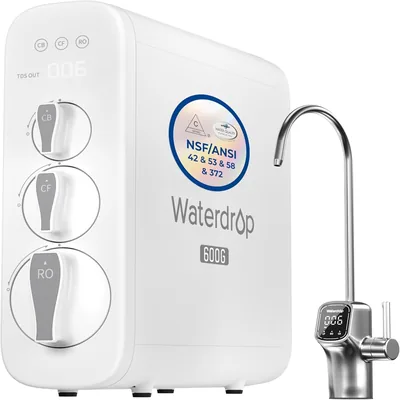
Waterdrop G3P800 Alkaline Reverse Osmosis System
Its current IAPMO R&T performance sheet records model-specific NSF/ANSI 53 results for Total PFAS (>99%), PFOA (>98%) and PFOS (>99%) under the report's test conditions. It is also documented to NSF/ANSI 42, 53 and 58 for the claims listed in that sheet.
Waterdrop G3P600 Reverse Osmosis System
Waterdrop's current product page says this model helps reduce PFAS. However, the performance sheet currently linked from that page does not list named PFAS results such as PFOA or PFOS. That does not mean it cannot reduce PFAS; it means I cannot honestly present it as a model with independently documented PFAS results today.
It may suit someone looking for a compact RO system with broader documented claims. For a PFAS-first decision, compare the model's current paperwork with the G3P800 report above before buying.
Review G3P600 documentation at WaterdropFrequently Asked Questions
Do water filters remove PFAS?
Some systems can reduce some PFAS. The strength of the evidence depends on the exact model and which compounds were tested. Check the model-specific performance sheet rather than relying on a general filter category or a headline percentage.
What is NSF P473?
It is an NSF testing protocol associated with PFOA and PFOS reduction claims. Treat it as a useful signpost, then check the named model's report for the compounds and filter life covered.
Does boiling water remove PFAS?
No. Boiling is not a PFAS-removal method and can concentrate what remains as water evaporates.
Is PFAS in UK tap water?
PFAS has been found in environmental and water-supply studies, but levels and compounds vary by place and over time. Check your supplier's information and seek appropriate testing if you have a specific local concern.
Related Guides
PFAS in UK Water: Complete Guide
A wider look at “forever chemicals” and UK context
Check Your UK Water Company
Find your supplier and regional water context
Best Filters for Lead Removal
The different evidence to look for if lead is your concern
Is UK Tap Water Safe?
The practical facts, without fear-mongering
Accuracy and affiliate note: This page was reviewed on 30 August 2026. Product specifications, certifications, test documents and prices can change, so always check the manufacturer's current performance data before buying. Some outbound links are affiliate links; they may earn Filter Authority a commission at no extra cost to you and do not change the evidence standard used here.