Best Water Filters UK 2026
Independent Picks for Every Budget
I always wince a little when someone asks me "what's the best water filter then?"
My honest answer? "Best for what?"
Because here's the truth after 25 years in filtration — no single filter is best at everything. The best filter for removing lead is a completely different product from the best filter for removing odd tastes or smells. Ask me for the best at most things in general and I'd point you toward a reverse osmosis system. Ask me about strange smells and a simple jug filter might do the job perfectly well for a fraction of the price.
And "best" means more than just filtration performance. Price matters. Build quality matters. How long the brand has been around matters. Whether replacement filters are easy to find in the UK matters. And so does customer service — because when something goes wrong six months down the line, you want a brand that actually answers the phone and has the parts available.
So before you scroll down — try to refine what you're actually looking for. Best filter for lead? Best for chlorine taste? Best for PFAS? Best for a renter who can't drill holes?
Tell me your specific situation and I'll give you a straight answer.
In a Hurry? Here's What to Buy
Picks verified against NSF/ANSI certifications. 25 years industrial coatings filtration.
iSpring RCC7AK — check current price
Six-stage RO with alkaline remineralisation. The linked bare RCC7AK is NSF-listed for TDS reduction; check its exact current configuration for any specific contaminant concern.
Buy on Amazon →Waterdrop 10UA — £59
IAPMO R&T NSF/ANSI 42 scope for aesthetic chlorine, taste and odour reduction. Not promoted here for lead, PFAS or microplastics concerns.
Buy at Waterdrop →BRITA Marella Jug — £20.99
Reduces chlorine taste. No installation needed.
Buy on Amazon →Want to understand why these are my picks? Read the full reviews below ↓
Why I Started Reviewing Filters
Twenty years ago, I bought my first water filter after reading about lead pipes in older homes. I spent £400 on what the salesman called "the best system on the market." It was overkill for my needs, complicated to maintain, and I replaced it two years later with something simpler that did exactly what I needed for a fraction of the cost.
That experience taught me something important: the "best" filter isn't the most expensive one or the one with the most features—it's the one that solves YOUR specific problem without breaking the bank or making your life complicated. That's what this guide is about.
The UK water filtration market has exploded in 2025-2026, driven by growing concerns about PFAS "forever chemicals", microplastics in tap water, and high-profile incidents like the Thames Water £122.7M fine and the Brixham cryptosporidium outbreak. I use current product documentation, certification records and reader feedback to separate useful claims from marketing noise. Here's what to check—and what you can skip.
🎯 Quick Navigation
- Budget Filters (£50-150) - Best value for money
- Mid-Range RO Systems (£200-350) - Compare model-specific documentation
- Premium Smart Systems (£400-600) - Latest technology
- Side-by-Side Comparison Table
- How to Choose - Decision framework
A Simple Guide to Which Filter Type Usually Suits Which Concern
A simple guide to which filter type usually suits which concern.
Jug Filters
Typical price: £20-40Best for improving chlorine taste and odour, with no installation needed.
Under-Sink Carbon Filters
Typical price: £80-150A good middle-ground option for better taste, odour, sediment, and some chemical reduction.
Multi-Stage Under-Sink Systems
Typical price: £150-300Designed for broader reduction, but performance varies by model and certification.
Reverse Osmosis Systems
Typical price: £200-400A broader filtration option; for lead, PFAS, fluoride or microplastics, check the exact model's current performance evidence.
Whole-House Systems
Typical price: £500-2000+Best for protecting appliances and treating water throughout the home, rather than just at one drinking tap.
Most UK homes do well with a simple under-sink carbon filter or a reverse osmosis system, depending on the concern. If you are worried about lead pipes or broader contaminant reduction, start by comparing certified under-sink and RO options carefully.
Before You Buy Any Filter
Check your water pressure first. Reverse osmosis systems need adequate pressure to work properly, and some homes may need a booster pump. Read the essential pre-purchase checklist →
Why Switch from Bottled Water?
A home filter can reduce plastic waste, cut long-term costs, and make everyday drinking water more convenient. Read the full guide →
Last updated: October 2026. Prices, certifications and availability can change; always check the exact current model before buying.
Best Budget Filters (£50-150)
Best for: taste improvement, sediment, and everyday under-sink filtration
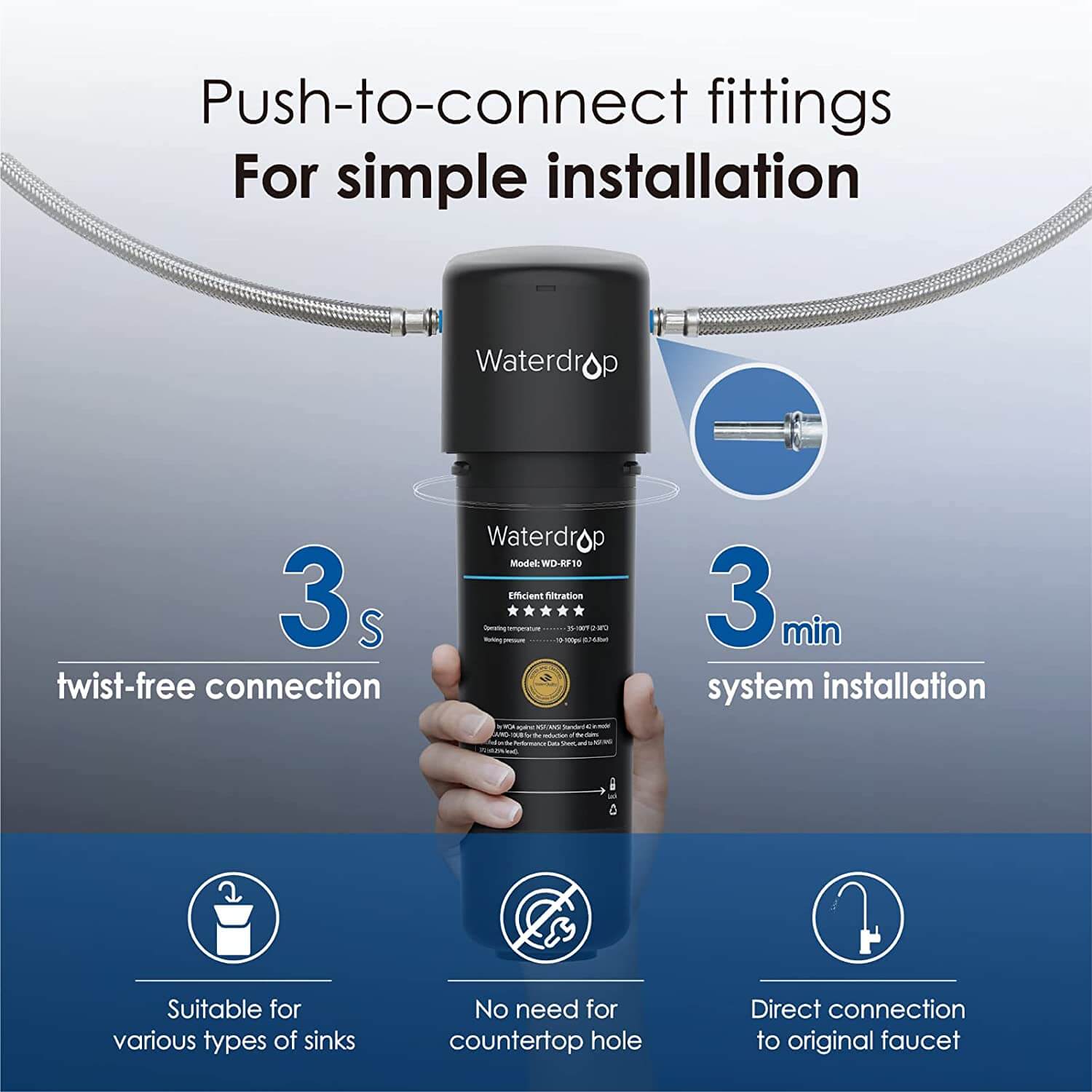
Waterdrop 10UA Under Sink Water Filter
What it is designed to reduce:
- • Aesthetic chlorine, taste and odour — IAPMO R&T NSF/ANSI 42 scope
Important note: The current certificate does not list lead, PFAS or microplastics reduction. Do not choose this model for those concerns; use the relevant evidence-led guide instead.
Key specs:
- • Installation: direct-connect under-sink format; check compatibility and landlord permission
- • Certification: IAPMO R&T certified to NSF/ANSI 42-2022 for aesthetic chlorine, taste and odour reduction
- • Capacity: Waterdrop’s certificate and UK page show different figures; confirm the current supplied model and replacement guidance before buying
Why I like it:
The Waterdrop 10UA is a strong budget choice for people who mainly want better-tasting drinking water and a simple under-sink setup. It is affordable, easy to install, and has a very strong review base compared with most alternatives in this price range.
Best for:
- • Renters with permission to fit an under-sink unit
- • First-time buyers
- • Households focused mainly on taste and everyday improvement
- • People who want a low-cost upgrade without going full RO
💚 Ships to Northern Ireland: Amazon UK delivers via FBA.See NI delivery FAQ
Tip: Check both retailers before buying, as direct offers and warranty terms sometimes differ.
Looking for an alternative to the 10UA? The Waterdrop 10UA is a straightforward under-sink option for taste and odour. If your concern is lead or PFAS, see our lead guide or PFAS guide and compare exact model-specific evidence before choosing a system.
Best Mid-Range RO Systems (£200-350)
Best for: buyers prepared to compare exact model-specific performance documentation
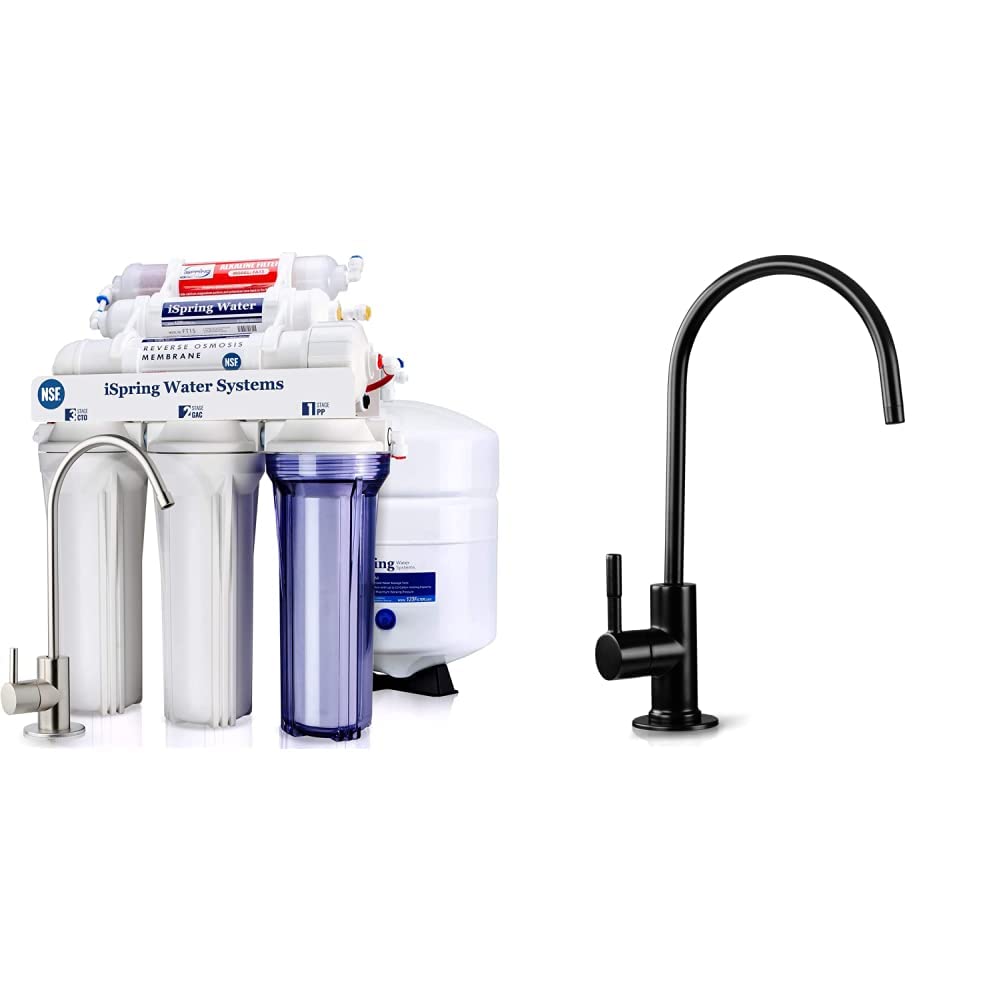
iSpring RCC7AK 6-Stage Reverse Osmosis System
What it is designed to reduce:
- • TDS reduction in the exact NSF-listed RCC7AK configuration
- • Alkaline remineralisation as a stated system feature
- • Specific contaminant claims: check the exact current model and replacement-module documentation
Key specs:
- • Stages: 6 (RO + alkaline remineralisation)
- • Production: 75 GPD
- • Tank: 3.2 gallon storage tank
- • Waste ratio: approximately 3:1
- • Filter life: 2–3 years (membrane), 6–12 months (pre-filters)
- • Annual running cost: roughly £60–80 for replacement filters
Why I like it:
The linked iSpring RCC7AK is a 6-stage RO system with alkaline remineralisation. For this exact bare RCC7AK configuration, NSF lists NSF/ANSI 58 certification for TDS reduction. Retailer ratings and stock change, so check the current listing rather than relying on a fixed review count.
For a particular lead, PFAS or particle concern, do not choose an RO system by category alone. Compare an exact model’s current performance sheet and certification scope before buying.
Best for:
- • Buyers who want an under-sink RO system with alkaline remineralisation
- • Households able to compare model-specific documentation before purchase
- • Buyers comfortable with a more involved installation and replacement schedule
UK buyers: what to know
This model uses standard push-fit connections that are generally suitable for under-sink installation, but always check your plumbing setup before buying.
Installation
- • Standard push-fit fittings
- • Parts included
- • DIY possible for confident buyers
- • Some households may prefer a plumber
Good fit for
- • Buyers considering alkaline remineralisation
- • Homes with suitable pressure and space for an under-sink system
- • Buyers willing to check the exact listed configuration
Water pressure note
RO systems need adequate pressure to perform properly. If your pressure is low, you may need a booster pump before installing one.
Hard water note
In harder-water areas, an RO membrane may wear faster without pretreatment. If you live in a very hard-water area, look into whether a softener or other pretreatment makes sense before buying.
💙 Ships to Northern Ireland: Amazon UK delivers via FBA.See NI delivery FAQ
Best Premium Smart Systems (£400-600)
Best for: buyers who want stronger efficiency, modern features, and a more compact RO design
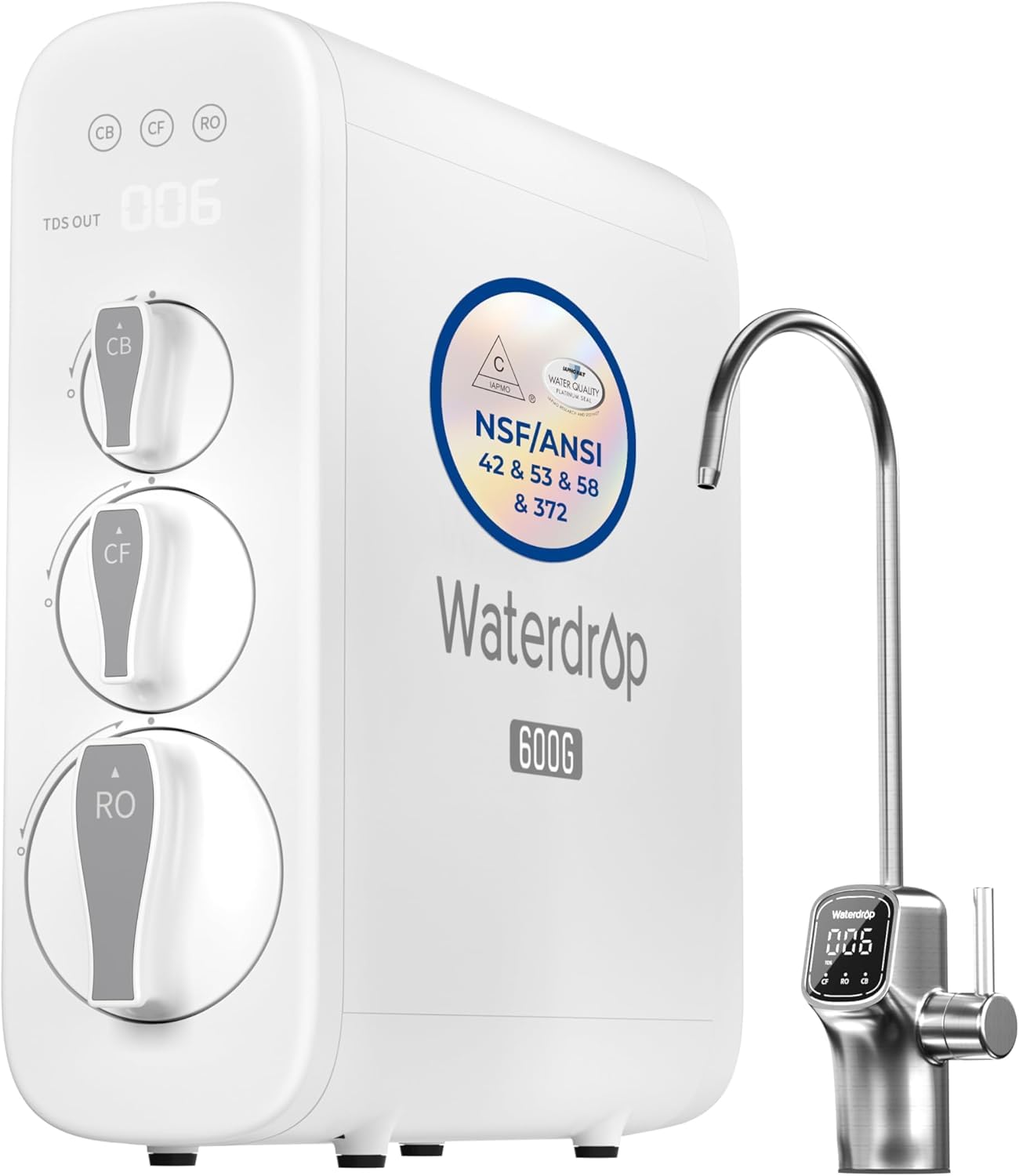
Waterdrop G3P600 Smart Tankless RO System
Key features:
- • Smart TDS display
- • Tankless design
- • More efficient waste-water ratio than many standard RO systems
- • Faster water production
- • Filter life indicator
Check the exact performance sheet:
The linked G3P600 sheet names specific results for chlorine, TDS, cadmium, hexavalent chromium, selenium, fluoride and listed 401/VOC substances under its test conditions. It does not name lead, PFAS or microplastics results.
- • Tankless RO design
- • Smart TDS and filter-life display
- • Stated 2:1 pure-to-drain ratio
Why I like it:
The G3P600 is a more modern take on reverse osmosis, with useful convenience features and a better space-saving design than traditional tank systems. It is especially attractive for households on a water meter or anyone who values efficiency and cleaner under-sink installation.
Best for:
- • Tech-minded households
- • Metered homes
- • Buyers who want a tankless setup
- • Families wanting a more premium RO experience
Frizzlife WB99-H Countertop RO System
No installation required, which makes it attractive for renters or buyers who do not want to modify plumbing. It is more expensive than many under-sink options and takes up counter space, so convenience is the main reason to choose it.
⚠️ Fewer reviews than we'd normally recommend — only 321 at time of writing, against our usual 1,000 minimum. Check current ratings before buying, and treat this as a secondary option rather than a primary pick. If you need a countertop RO with more independent feedback behind it, the Waterdrop G3P600 (under-sink, 30-min install) is a better-evidenced choice.
Premium All-in-One Countertop RO: Osmio Zero 3.0

The Osmio Zero 3.0 is more than a water filter — it replaces your kettle entirely. Place it on your worktop, fill the tank, and get instant hot, chilled, or ambient RO-purified water on demand. No plumber, no under-sink space needed. It also generates molecular hydrogen water and includes built-in UV sterilisation for an extra layer of safety.
Honest note: Removes bacteria, chlorine, fluoride, nitrates, heavy metals, hormones, and pharmaceuticals. Requires mains water pressure 0.4–0.6 MPa. Filters last 6–12 months; replacement set is £79.50. The inner liner is plastic — this is a countertop appliance, not a glass unit.

Osmio Fusion 3.0 Installed Hydrogen RO System
The Fusion 3.0 is the installed version of the Zero 3.0 — it connects directly to your mains water supply (no tank to fill) and delivers continuous hot, chilled, and hydrogen-enriched RO water from a dedicated tap. Ideal for families who want permanent, high-capacity RO filtration without the countertop footprint.
Installation note: Connects to your cold mains supply — straightforward for a competent DIYer, handyman, or plumber. Requires water pressure 0.4–0.6 MPa. Filters (shared with Zero 3.0) last 6–12 months at £79.50 per set.
Waterdrop X16 Alkaline Under-Sink RO System
Waterdrop’s flagship under-sink RO system: 1,600 GPD flow, 11-stage filtration, alkaline remineralisation, UV protection and a smart faucet with live TDS display.
Waterdrop X12 Alkaline Under-Sink RO
- ✓ NSF/ANSI 42/58/372 certified
- ✓ 1200 GPD, 11-stage filtration, alkaline minerals
- ✓ Tankless, smart monitoring
Note: New product — only 6 reviews at time of writing. Strong specs from an established brand.
View X12 on Waterdrop UK →Waterdrop A1 Hot & Cold RO Dispenser
- ✓ Installation-free 7-stage RO system
- ✓ Hot and cold water with dual UV sterilisation
- ✓ A premium worktop option for homes that cannot fit an under-sink system
Newer product with a smaller review base; check the current rating, specifications and suitability before buying.
View A1 on Waterdrop UK →Waterdrop G2P600 Tankless Under-Sink RO
- ✓ 600 GPD fast flow, tankless design
- ✓ 2:1 water saving ratio, space-saving
- ✓ Quiet operation, safe materials
Waterdrop K6 Instant Hot Under-Sink RO System
The only under-sink RO system with instant hot water on demand (25–95°C). Replaces your boiling water tap at a fraction of the cost. Slim 17cm profile fits under almost any sink. Smart digital faucet shows TDS and has a child lock.
- ✓ 5-stage RO filtration
- ✓ Instant hot 25–95°C, 1.5L/min fast flow
- ✓ Slim 17cm design — fits tight spaces
- ✓ Smart digital faucet with TDS display
- ✓ Child lock for hot water safety
- ✓ 2:1 water saving ratio
More Osmio Options — Gravity, Portable RO & Hydrogen
Osmio Clarity Gravity Water Filter
Borosilicate glass housing with mango wood stand — the most beautiful gravity filter on the market, and one of the most capable. Osmio Cerametix filters remove bacteria, E-coli, chlorine, fluoride (up to 97%), pharmaceuticals, and heavy metals. No electricity, no plumbing, no installation. Includes a free Osmio Sanser Sanitiser Spray (£59 value) while stocks last.
- ✓ Borosilicate glass + mango wood — minimal plastic contact
- ✓ NSF 42 certified filter materials
- ✓ Removes fluoride (up to 97%) without activated alumina
- ✓ Removes bacteria, E-coli, heavy metals, pharmaceuticals
- ✓ Gravity-fed — no electricity or plumbing needed
- ✓ 7L upper + 7L lower reservoir
- ✓ 304 stainless steel dispensing tap
- ✓ Suitable for 1–4 people
Honest notes: Flow rate is 1–2 L/hr (gravity is slow — fill overnight). Does NOT reduce limescale significantly (~30%). Glass is fragile — handle with care. Graded version available at £205 (cosmetic blemishes only). Free Sanser Spray (£59) included while stocks last.
Osmio Zero 2.0 Portable RO System
Note: This is the Zero 2.0 (countertop/portable). The Zero 3.0 (£649.99, hydrogen RO) is listed separately above.
- ✓ RO water purifier AND instant kettle in one
- ✓ No installation — just plug in and fill
- ✓ Ambient, warm (50°C), hot (88°C), near-boiling (95°C)
- ✓ 3-stage filtration with mineral ceramic after-filter
- ✓ 80% more energy efficient than a regular kettle
- ✓ 3-year warranty
Honest notes: Max hardness 250ppm — harder water needs more frequent filter changes. White only. Replacement filter pack: £62.90.
Osmio Duo 2.0 Hydrogen Water Bottle 400ml
- ✓ PEM + SPE technology — pure H2 only (oxygen separated out)
- ✓ ORP: -300 to -750 mV, H2: 1100–2000 ppb
- ✓ Borosilicate glass body, platinum-titanium electrode
- ✓ Dual use: hydrogen-enriched water + nasal cannula for breathing
- ✓ Works with any water type (tap, mineral, RO)
Honest note: New to the Osmio range — only 2 reviews at time of writing, but strong pedigree from an established UK brand. Hydrogen has a 2-hour half-life after generation — drink promptly. Battery and glass not covered by 1-year warranty.
Side-by-Side Comparison
| Feature | Waterdrop 10UA (Budget) | iSpring RCC7AK (Mid-Range) | Waterdrop G3P600 (Premium) |
|---|---|---|---|
| Typical price | Check current price | Check current price | Check current price |
| Review volume | Check current retailer rating | Check current retailer rating | Check current retailer rating |
| Best for | Aesthetic chlorine, taste and odour reduction | RO system with alkaline remineralisation; exact NSF scope is TDS reduction | Tankless RO, smart monitoring and stated 2:1 efficiency |
| PFAS performance | No current exact-model PFAS result verified | No current exact-model PFAS result verified | No named PFAS result in the linked performance sheet |
| Microplastics | No exact-model microplastics result verified | No exact-model microplastics certification verified | No exact-model microplastics result verified |
| Fluoride reduction | Not the right choice | Yes, typical RO strength | Yes, typical RO strength |
| Lead concerns | Not promoted here for lead reduction | Not assessed for lead until the exact certified SKU is identified | Do not choose for lead here without a current sheet naming lead |
| Filter lifespan | 2–3 years | Membrane 2–3 years | Membrane 2–3 years |
| Annual running cost | £35–40 | £60–80 | £70–90 |
| Waste water | None | Typical RO waste ratio | Improved RO waste ratio |
| Installation | DIY, around 30 mins | DIY or plumber | DIY or plumber |
| Space needed | Minimal | Under-sink tank required | Smaller tankless footprint |
| Smart features | No | No | Yes |
| Best suited to | First-time buyers, renters, basic upgrades | Families, older homes, broader filtration needs | Buyers wanting convenience, efficiency, and premium design |
How to Choose the Right Filter
Which Category Suits Your Situation?
Budget under-sink filter (£50-150) suits you if:
- You mainly want to improve chlorine taste and odour
- You are a renter or first-time filter buyer
- You want easy DIY installation (typically around 30 minutes)
- You do not need fluoride or lead reduction
- You want a simple, affordable everyday upgrade
Suggested starting point: Waterdrop 10UA (£59.48)
Mid-range reverse osmosis (£200-350) suits you if:
- You are concerned about lead, PFAS, or fluoride and want broader reduction
- You want stronger microplastics reduction than a carbon filter alone
- You have a family with young children and want extra reassurance
- You are comfortable with a typical RO waste-water ratio
- You live in a hard water area and are willing to pair with a softener
Suggested starting point: use the iSpring RCC7AK section to compare the exact current model documentation.
Premium smart RO (£300-600) suits you if:
- You want a more efficient waste-water ratio than traditional RO systems
- You are on a water meter and want to minimise waste
- You want smart monitoring (TDS display, filter life indicator)
- You prefer a tankless, space-saving design under the sink
- You value convenience and a more modern setup
Suggested starting point: use the G3P600 section to compare the current named performance sheet and price.
Regional Considerations
London & Southeast (Hard Water Areas)
Hard water areas can shorten RO membrane life. If you choose an RO system, pairing it with a water softener is worth considering to protect the membrane and reduce long-term running costs.Learn more →
Scotland & Wales (Softer Water Areas)
Softer water is gentler on RO membranes, so a softener is usually unnecessary. A budget carbon filter may be enough for taste and odour concerns. Scotland has stricter PFAS testing requirements, but an RO system still provides extra reassurance if that is a concern.
Northern Ireland (Belfast & Rural Areas)
Belfast has moderate-to-hard water, so a softener may help if choosing RO. Rural areas on private well water may benefit from an RO system for broader contaminant concerns.All products ship to NI via Amazon →
Manchester, Birmingham, Leeds (Moderate Water)
Moderate hardness areas can work well with either a budget carbon filter for basic taste improvement or an RO system for broader concerns. A softener is optional but worth considering if you go the RO route.
Frequently Asked Questions
Do I really need a water filter in the UK?
UK tap water is highly compliant with safety standards when it leaves treatment works. However, older properties can still have lead pipework. The Drinking Water Inspectorate advises checking homes built before 1970 and seeking water-company guidance or a kitchen-tap test where lead is suspected. A filter decision should follow evidence for the exact model and concern, rather than a national prevalence estimate.
What's the difference between carbon filters and RO systems?
Carbon filters such as the Waterdrop 10UA can be a good fit for taste and odour; the current 10UA certificate is specifically for aesthetic chlorine, taste and odour reduction. RO systems may have broader documented claims, but those claims vary by exact model and configuration. For lead, PFAS, fluoride or microplastics, compare the current named performance sheet before buying rather than relying on the technology category alone. Read the full RO vs carbon comparison →
Do RO systems remove healthy minerals?
Yes, RO systems are designed to reduce most dissolved solids, including minerals like calcium and magnesium.Solution: Choose an RO system with alkaline remineralisation (like the iSpring RCC7AK), which adds minerals back after filtration. It is also worth remembering that most people get far more minerals from food than from drinking water.
Will RO waste water cost me a fortune?
Traditional RO systems waste 3-4 gallons per gallon filtered. For a family of 4 drinking 2 liters/day, that's ~£30-50/year in waste water costs if you're metered. Solution: Choose a modern tankless RO system like the Waterdrop G3P600 (2:1 waste ratio), which cuts waste in half. Or, if you're unmetered (multi-story flat, shared supply), waste water is free.Read full cost analysis →
Can I install these filters myself?
Budget carbon filters: Yes, 30-minute DIY installation. No plumbing experience needed.RO systems: DIY possible (1-2 hours) if you're comfortable with basic plumbing (connecting water lines, drilling holes). Otherwise, hire a plumber (£100-200). All systems include detailed instructions and YouTube videos.
Do these filters work in Northern Ireland?
Yes! All products listed ship to Northern Ireland via Amazon UK FBA (no Brexit customs issues). Northern Ireland Water serves all of NI with moderate-hard water in Belfast/East and soft water in the West.See full NI delivery FAQ →
How often do I need to replace filters?
Carbon filters: Every 2-3 years (11,000-19,000 gallons).RO pre-filters: Every 6-12 months.RO membrane: Every 2-3 years (4-5 years with water softener in hard water areas). Most systems have filter life indicators or LED displays to remind you. See our full filter replacement guide →
Does boiling water remove chlorine?
Yes, boiling water for 15-20 minutes can reduce chlorine, but it won't remove chloramine (used by many UK water companies), lead, PFAS, or microplastics. A dedicated filter is more practical and effective for daily use. Read the full guide on boiling vs filtering →
What about whole house water filters?
Whole house filters treat water at the point of entry, so every tap gets filtered water. They're best for sediment, chlorine taste, and protecting appliances from limescale. For contaminant-specific concerns (lead, PFAS), you'll still want a dedicated under-sink or RO system at the kitchen tap. See our whole house filter guide →
Does a TDS reading of 000 mean my water is safe?
No. TDS (Total Dissolved Solids) measures dissolved minerals, not specific contaminants. A reading of 000 just means very few dissolved solids — it tells you nothing about bacteria, PFAS, or microplastics. And some dissolved minerals are actually beneficial. Read why TDS doesn't tell the whole story →
Final Recommendations
Best Budget Choice: Waterdrop 10UA
A strong entry-level under-sink filter for households mainly focused on better taste, chlorine reduction, and a simple everyday upgrade. It is easy to install, relatively affordable to run, and backed by a very large review base. Best for people who want a straightforward improvement without stepping up to reverse osmosis.
Best for: taste, odour, sediment, and simple under-sink filtration
Not ideal for: lead concerns or buyers wanting broader reduction across multiple contaminants
Check Price at Waterdrop →Best for Broader Contaminant Reduction: iSpring RCC7AK
A well-established reverse osmosis system that suits households wanting a more comprehensive filtration setup, especially where lead, fluoride, PFAS, or microplastics are part of the concern. It is a stronger choice than a basic carbon filter when you want broader performance and are comfortable with a more involved installation.
Best for: families, older homes, and broader contaminant concerns
Not ideal for: buyers who want the simplest install or the lowest ongoing maintenance
Check latest price on Amazon →Best Premium Upgrade: Waterdrop G3P600
A more modern tankless RO system with smart monitoring, a neater under-sink footprint, and better efficiency than many traditional RO designs. A good fit for buyers who want convenience, cleaner installation, and more premium features.
Best for: tech-minded households, metered homes, and premium buyers
Not ideal for: tight budgets or people who simply want basic taste improvement
G3P800 adds UV sterilisation and 3:1 waste ratio. See our comparison →
Simplest Taste-Only Option: BRITA Marella Jug
A low-cost, no-install option for people who mainly want to improve chlorine taste and odour. Easy to live with and widely available, but not the right tool for more serious contaminant concerns.
Best for: convenience, taste improvement, and very low upfront cost
Not ideal for: lead, PFAS, fluoride, or broader contaminant reduction
Check latest price on Amazon →Still Not Sure Which Filter Fits Your Home?
Start with the concern, not the brand.
Ready to Compare Prices?
All links open in a new tab. Compare prices before you commit.
Waterdrop 10UA — taste and odour option
IAPMO R&T certified to NSF/ANSI 42 for aesthetic chlorine, taste and odour reduction. Not promoted here for lead, PFAS, VOC or microplastics concerns.
iSpring RCC7AK — RO system with alkaline remineralisation
The linked bare RCC7AK is listed by NSF for TDS reduction. Lead claims belong to specified -BLK/-BN systems and must not be assumed for this listing.
Waterdrop G3P600 — Best for efficiency and smart monitoring
Tankless design, stated 2:1 pure-to-drain ratio and real-time TDS display. Check the current model-specific performance sheet for named contaminant claims.
BRITA Marella Jug — Simplest option for taste improvement only
Reduces chlorine taste. No installation needed. Not designed for contaminant removal beyond basic taste and odour.
Prices shown are approximate and may change. As an Amazon Associate and Waterdrop affiliate, Filter Authority may earn from qualifying purchases. That does not affect our recommendations — we recommend the same products we would suggest to family.
About Keith
25 years working in industrial coatings filtration, including 18 years building and refining RO, carbon and resin systems
On Filter Authority, Keith translates hands-on experience into plain-English guidance and evidence-led, certification-aware recommendations for UK homes. You won't find hype here — just clear options, honest trade-offs, and how to check claims for yourself.
Read full bio and methodologyRelated Reading
The Protection Ladder: 6 Levels of Home Filtration
From simple taste improvement to maximum practical protection — find the right level for your household
Signs Your Filter Has Stopped Working
7 warning signs your filter needs replacing - know when it's time
PFAS in UK Drinking Water
Guardian investigation findings, UK vs US standards, and which filters remove PFAS
Belfast Water Quality Guide
Lough Neagh crisis, lead pipes, and Northern Ireland water quality explained
Filter Types Explained
Complete guide to carbon, RO, UV, and water softeners for UK homes
Hard Water Guide for UK Homes
London and Southeast water hardness map, limescale damage, and softener recommendations
Water Filter Certifications Explained
NSF 42, 53, 401, P473 and WRAS — what they mean and how to verify a filter's claims
Water Filter Installation Guide
Step-by-step installation guide for under-counter water filters
Water Filter Cost Calculator
Work out the true cost of ownership including filters, water waste, and energy
Water Softener vs Water Filter
They solve different problems — here's how to decide which you need
Best Water Filters for Tea & Coffee Lovers
How the right filter transforms your brew — chlorine, limescale, and taste explained
Whole House Water Filters UK
Point-of-entry filtration for every tap — when it makes sense and what to expect